
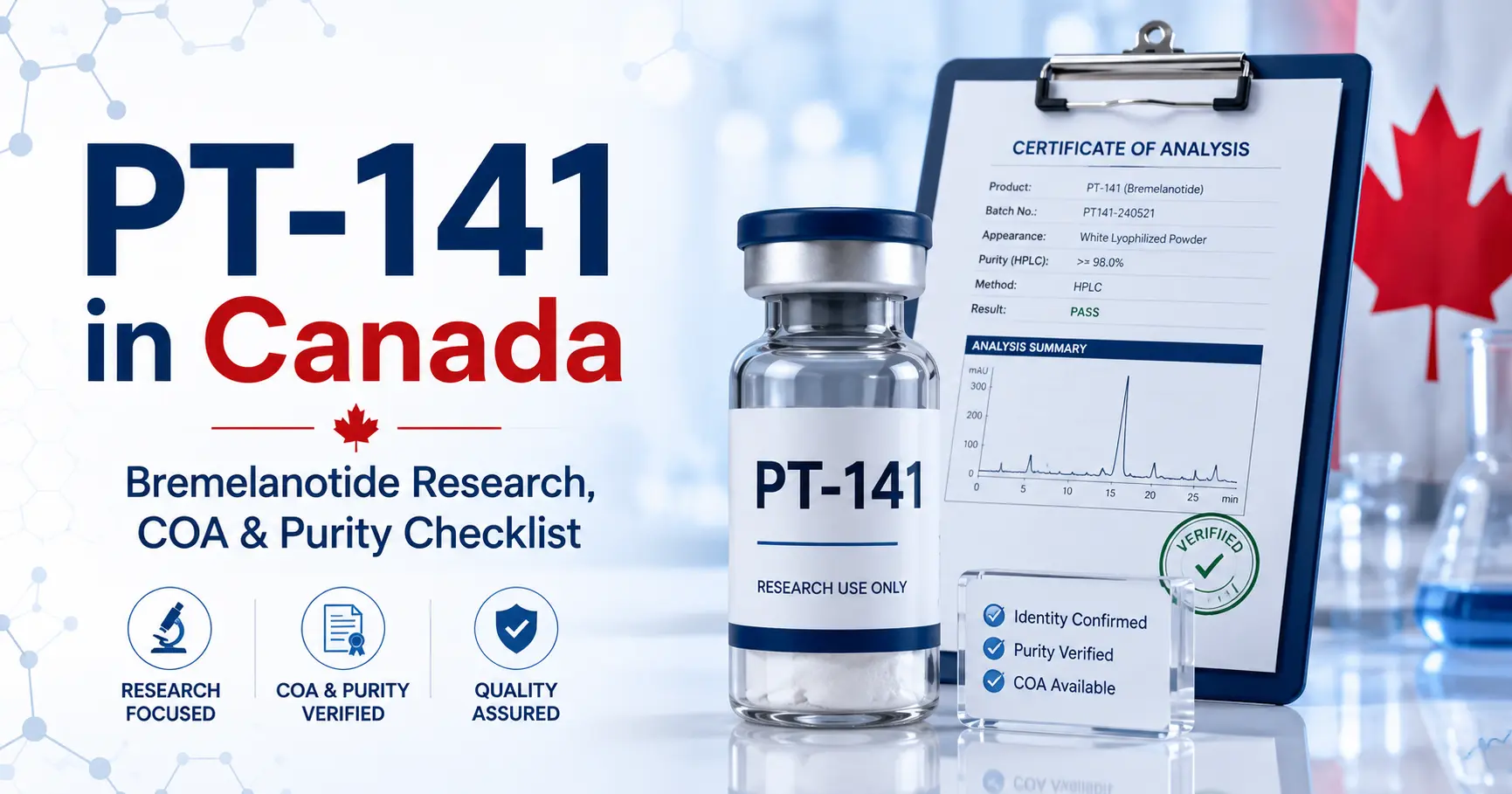
PT-141 in Canada: Bremelanotide Research, COA & Purity Checklist
Quick answer: PT-141, also called bremelanotide, is a melanocortin-receptor agonist. Unlike many research peptides, bremelanotide has been approved as a prescription drug in some jurisdictions (e.g., FDA-approved as Vyleesi for a specific condition), though it is not a general consumer product. As with any peptide, quality is judged by a batch-specific COA showing HPLC purity and mass spec identity.
PT-141 (bremelanotide) is a melanocortin-system peptide with an unusual status among research peptides: it’s been through formal drug approval in at least one major jurisdiction. This article explains what it is, how its mechanism works, its regulatory standing, and — since documentation is how quality is judged — how to read a COA for it.
What PT-141 is
PT-141, or bremelanotide, is a synthetic peptide derived from an earlier compound called melanotan II. It acts on the melanocortin receptor system, a signaling network involved in a range of physiological processes including pigmentation, inflammation, energy balance, and sexual function.
Bremelanotide was developed and studied specifically for its effects mediated through this system, and unlike most peptides marketed for “research,” it completed clinical trials and regulatory review for a defined medical indication.
How the melanocortin mechanism works
The melanocortin system consists of several receptor subtypes (MC1R through MC5R), each tied to different functions:
- MC1R — pigmentation
- MC3R and MC4R — energy balance, and central nervous system pathways including those involved in sexual response
- MC5R — various peripheral functions
Bremelanotide is a non-selective agonist that activates several of these receptors, with its studied effects on sexual function attributed mainly to central MC4R activity. This central mechanism is what distinguishes it from how most treatments in that space work, which act on the vascular system.
Regulatory status
This is where PT-141 differs from many research peptides:
Bremelanotide is an approved drug in some jurisdictions. In the United States, the FDA approved it (brand name Vyleesi) for a specific condition in certain patients. That means it has been through formal evaluation of safety and efficacy for that indication — a level of characterization most research peptides never reach.
In Canada, you should verify its current Health Canada status directly, as approval status varies by jurisdiction and changes over time. Importantly, even where bremelanotide is approved, it’s a prescription medicine for a defined use, not a general consumer product — material sold as a “research” peptide is outside that approved, supervised framework.
I’d treat that distinction as the important one: an approved prescription drug is meant to be used under medical supervision for a diagnosed condition, which is different from sourcing the compound independently.
Reading a COA for PT-141
For any peptide, the COA is the document that separates verifiable quality from a claim. A legitimate one is batch-specific — tied to the exact lot — not a generic PDF reused across products. Here’s what to check.
Header details
- Product name (bremelanotide / PT-141) and sequence
- Batch or lot number matching the physical product label
- Test date, recent and plausible
- Named testing lab, ideally independent
HPLC purity
- A purity percentage, ideally 98% or higher
- The actual chromatogram — one dominant target peak, minimal impurity peaks — not just a stated number
Mass spec identity
- An observed molecular weight matching the expected weight for the sequence
- This confirms it’s the right molecule; purity alone doesn’t
Verification
- Match the batch number to your product
- Confirm the lab exists and is named
- Watch for reused COAs across batches — each batch should have its own
You can review available COA records here to see what batch-specific documentation should look like.
Purity checklist
| Element | What to confirm |
|---|---|
| Batch number | Matches the physical product |
| Test date | Recent and plausible |
| HPLC purity | 98%+, with a visible chromatogram |
| Mass spec | Observed weight matches expected |
| Lab | Named, independent, verifiable |
| Batch-specific | Not reused across products |
Frequently asked questions
What is PT-141?
PT-141 (bremelanotide) is a synthetic melanocortin-receptor agonist. It acts on the melanocortin system and, unusually for a research peptide, has been approved as a prescription drug in some jurisdictions.
How does it work?
It activates melanocortin receptors, with its studied effects attributed mainly to central MC4R activity — a different mechanism from vascular-acting approaches.
Is PT-141 approved in Canada?
Verify current status with Health Canada directly. It’s FDA-approved in the US as a prescription medicine for a specific condition; even where approved, it’s a supervised prescription drug, not a general consumer product.
What purity should a PT-141 COA show?
For research applications, 98%+ supported by an HPLC chromatogram, plus mass spec confirmation of identity — not just a stated figure.
How do I verify a COA is legitimate?
Match the batch number to your product, confirm the date is plausible, check the named lab exists, and make sure the COA isn’t reused across multiple batches. See the FAQ for how COA access works.